Monday, February 9, 2015

Interest Inventory


Student Interest Survey

I hope to get to know all of you to make this year as great as it can be.  Please share your thoughts on the following items with me.  Your input will be taken into consideration when shaping how our class is run.


Name:_________________________________________                              Period:_________________

Describe your ideal homework or studying environment.


What types of technology do you have access to, and where do you access them?


Rank from 1 to 4 (1 being most confident, 4 being least confident) how confident you are in completing the following types of math problems.
_____  Algebra problems                                    ______ Geometry problems
_____ Multi-step arithmetic (no calculator)   ______ Graphing linear equations


Describe your typical week outside of school. Include any jobs, sports, hobbies, clubs, or volunteer work.


What was your favorite math class?  What year was it, and what qualities made that class your favorite?


What is a goal you currently have, or something that you aspire to accomplish?


What is something I could do or keep in mind to help you have a successful year?


Sunday, February 8, 2015

Subjects Matter Chapters 1 and 2

The authors, Daniels and Zemelman, immediately make a compelling case for why reading deeply and thoroughly is so important.  The students at Best Practice High School read meaningful articles, understood what they were reading, and created projects which were relevant to their lives and to the lives of others.  This kind of learning reminds me of what Wilhelm talks about in the second chapter of the article we read.  Reading content for a real purpose, not just to be able to answer questions at the end of a chapter, is what inspires students.  Daniels and Zemelman make it a point to remind the reader that inspired students learn and retain the most.  
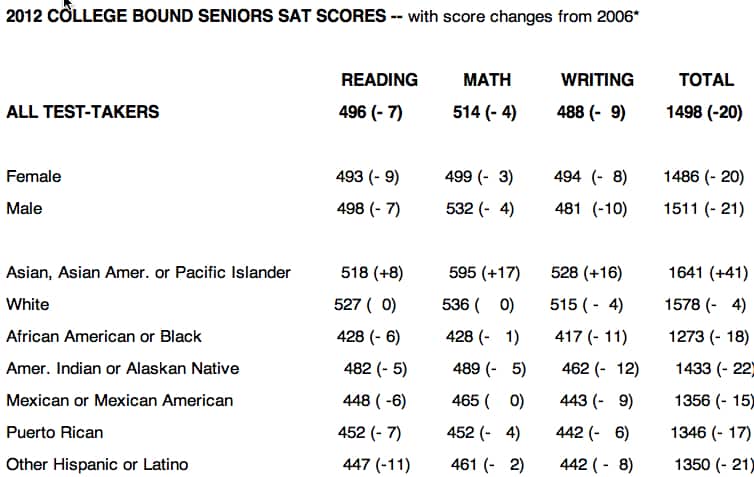
            I’m glad that they go on to talk about the over exaggeration of test scores that has been happening in recent years.  This was a topic that was covered last semester in Dr. Brell’s class and as a mathematician I feel strongly about this issue.  Everyone thinks test scores are going down and that the U.S. is so far behind other countries.  This is simply not the case.  More people than ever are taking the SATs and other standardized tests, so by increasing the test population the scores will stagnate or appear to decline even though students are improving overall.  Just having more students taking the test in the first place should be seen as an improvement regardless of their score because it means more students are motivated to go to college or pursue some other form of post-secondary education.  The authors also mention that if the U.S.’s most well off students are compared with other countries’ students, the U.S. is first in reading.  


This shows SAT scores going down, but what is not shown is a breakdown of the scores by socioeconomic status.  Our country's poorest students earn the lowest scores on the SAT, giving further evidence that poverty is probably the biggest issue in education.


This misconception that the U.S. is falling behind is corrected in Diane Ravitch’s recent book, Reign of Error, and I’m glad these authors are following her example and getting the truth out there.  Another point I appreciated in the first chapter was their critique of the Common Core Standards.  When I first read through the ones for math and other subjects, my initial impression was how dry and robotic they seemed.  The standards are populated by lists of “know this fact” and “be able to replicate this process”.  I like that the authors tell us not to be resigned to just following these lists and to make it a mission to use our content to inspire joy and a love of learning.

            The second chapter, was really eye opening for me, since it has been a while since I was really challenged by a reading.  You tend to forget how reading those stories felt in high school once you have been away from them for several years.  The examples they provided made me think about the students who give up and begin to dislike school because everything is “too hard”.  I think I would feel the same way if I was in their shoes, especially if I was an English language learner.  The chapter is a really effective reminder that we need to provide context for the content.  We need to build off of what they already know so the readings can make sense.  This focus on building the student’s schemata, or webs of prior knowledge, is something that really clicked with me when I read it.  As a math teacher I need to be conscious of what my students already know and what they don’t know.  I have to be careful not to send the students straight into reading a mathematical text.  They need to first be shown the commonly used abbreviations, the style in which theorems and proofs are presented, and then how examples flow in the different subjects.  Once they have a good background and some context from me, they can be more confident in themselves and more successful in their studies.  When the student feels they can succeed they are motivated to do so and that’s when the real learning can start happening.

Sunday, January 25, 2015

Literacy Profile

Over the years, I have become very literate in the sport of tennis.  I first took an interest in tennis when I was nine years old. I had tried playing other sports before, but I could not find one that I really loved.  During September of that year, I was watching the U.S. Open with my parents and I remember being extremely impressed by the competitors.  I decided that I wanted to learn how to play.  Neither of my parents played tennis.  Not really knowing anything about the sport, we bought a small kid size racket from Dick’s Sporting Goods and I signed up to take some lessons at the Rally Point Tennis Club in Smithfield. 
            The instructors there were a large part of why I began to love the sport so much.  Everyone was great to work with and I had a lot of fun going to play every week.  I soon started to sign up for leagues at the club and began playing several times each week year round.  I quickly started learning more from the instructors there.  I began to understand how to properly hit the ball with the different kinds of shots, how to construct points, how to position myself on the court, the rules of the game, and even things like the differences between the many kinds of rackets.  At the club, I began to work with Mike Petrarca who became one of my greatest influences.  He was a junior at Bishop Hendricken High School when I first took lessons from him and was a former New England champion.  He never thought it was too early for me to learn a more advanced shot or strategy and always pushed me to get better.  Unlike some of the instructors who would play a lot easier with the kids, he would play against me to test the very upper limits of my abilities.  Every time I would get better, he would hit harder shots against me and make me run farther to get to the ball.  I worked with him for many years, until I was a senior at Bishop Hendricken playing on the team as he did when I first met him. 
            Tennis is one of the hardest sports to master and remains a complicated one even after playing for years.  I would say that after playing all through middle and high school, I became literate in the sport.  Most of the practices used in tennis revolve around form, rules, and strategy.  All of the shots in tennis have a different form that allows you to hit the ball powerfully and accurately while keeping it within the boundaries.  For example, a literate tennis player will know the difference between a topspin forehand and a slice forehand, how to execute both of the shots, and what situations they should be used in.  The topspin forehand is a more aggressive shot used while the player is in control of the point.  This means that this player is deciding the pace of play.  To hit a topspin forehand, the player will take his racket back and down low with the face of the racket angled towards the ground.  When the ball is slightly out in front of him, he will swing forward from low to high finishing the swing over his other shoulder.  This technique generates the forward spin on the ball that causes it to accelerate after it bounces on the other side of the court.  The slice forehand is a more defensive or strategic shot and is used to slow down play giving the player time to recover and return the point to a neutral standing.  To hit a slice forehand the player will take his racket back in the same plane of the ball with the racket face angled towards the sky.  When the ball is just out in front of him, he will swing forward horizontally pushing through the ball and finishing the shot out in front of his other shoulder.  This is used to put a varying degree of backwards spin on the ball which when used correctly can cause the ball to bounce very low and slide across the court or cause it to lose all its speed after bouncing.  There are so many more literacies even within each shot that it takes a long time to learn and begin to master them all. 
After high school I finally truly knew the strategies for singles and doubles play, how to hit all the different shots, and had started gaining a wide knowledge of all the equipment involved in the sport.  It was also at this time that I decided that I wanted to take a break from playing competitively and start teaching tennis myself.  I worked as a tennis instructor for the four years I was in college.  I worked with people of all ages, from very young children to teenagers to adults and seniors.  I often look back on my experiences as a tennis instructor as I am preparing to be a teacher.  I learned how to work with a wide variety of people all coming from different backgrounds, having different skill levels, and having different strengths and weaknesses.  As an instructor, I always pushed the players I was working with as much as I could just like I was.  I have a strong belief that people only get better when they are playing someone better than them.  It is this challenge that allows for growth and this is a practice that will be my main focus as an educator.  Pushing a student to his limits, no matter how great or little, is what will make him succeed and be more confident as an individual. 

            The greatest lessons that I have learned from playing tennis are that progress and growth takes time, how to think and react to situations very quickly, and that there is always something new to learn.  No one just magically becomes a good tennis player over night or even over the course of a few months.  If I wanted to get better at a certain type of shot, I would hit that shot hundreds of times over and over again.   Even as I mastered the techniques, an entirely new challenge is thrown in when I have to adapt to what my opponent is doing. I must decide which of my practiced shots I will use, where I am going to move to, and where I am going to hit the ball to all during the amount of time it takes a tennis ball to travel 78 feet at 80 miles per hour.  This also happens to be my favorite part about the sport.  Even after playing for 14 years there are still new situations I find myself in all the time.  Each of these provides me an opportunity to learn something new about my own strengths and weakness, my strategies, and my progress as an athlete.  I can transition these attitudes the classroom by using each day to learn something new about my students and myself as a teacher and then improve my practices to meet the needs of my students.

Strategic Reading - Wilhelm

While reading Wilhelm’s Strategic Reading, the first thing that came to mind was how close I am to being in the situations he describes.  I want to be very prepared from a planning perspective like how Nate was, but at the same time I need to be able to answer all the tough questions about my own theories of learning.  In math, especially, the students are going to need to know why they are doing what they are doing and how it is going to help them.  We talked about this during a few classes of SED 406 and I have seen it enough firsthand to agree that giving a reason for learning helps motivate the students.  Wilhelm follows this up by asking the reader to rank situations based on the effectiveness of the teaching.  I found this to be quite challenging and I changed my answers around a few times before I settled on a list.  In the end I decided on the scenario of Tom’s piano performance having the most effective teaching and learning.  The teacher progresses Tom from a state where he is dependent on his teacher for help to a state where he can play the piece perfectly on his own.  The teacher guides Tom to success.  I ranked Maria, Arlene, and Jude as the next highest in that order.  I think that coming away from a class learning a skill or lesson beyond the content is sometimes more important than remember all the facts you learn in a course.  Frank and Peter rank fifth and sixth.  Frank can recite facts but did not learn anything since he can’t apply it to improve his golf score.  Peter did not teach his kids anything about not playing in the street, all he did was make them be afraid of getting hit.
            One point that stood out to me was something we talked a fair amount about in FNED 546 with Dr. Brell.  Teaching is a profession but most of the control lies in the hands of people who are not teachers.  I agree when Wilhelm says how we need to clearly state our theory of learning so that not just anyone thinks they could be a teacher and we can transition into a more defined profession.
            I also enjoyed the discussion of scaffolding and Vygotsky’s theories on teaching.  I think it is important to constantly challenge students to keep them engaged and actively learning.  So helping them constantly go a bit beyond their comfort zone, or as Wilhelm describes it, their Zone of Actual Development, and perform tasks in their Zone of Proximal Development seems like it would be greatly beneficial.  If the student is always working on tasks they can do by themselves without help, then the teacher has not taught them to do anything new.  The student just shows what they were already capable of doing.  The two sided model is beginning to be the model I most agree with rather than a model of teacher or student centered learning.  We began discussing the different models in SED 406 as well, and that’s when I first thought that guided practice would be more effective than all the lectures I sat through in high school and this reading has only further solidified my belief.
            The second chapter of the reading reminded me of what I saw in high school.  Everyone read the Spark Notes for the assigned book because we didn’t really understand the story.  I think being in a class like Wilhelm’s, when he uses all the outside examples of irony in comics, poems, and stories, would have been an excellent experience.  That kind of practice not only makes the learning relevant to the students, but helps them understand how irony works in every story, not just in one.  When reading this I immediately thought of using a website like The Onion as preparation to read a story like A Modest Proposal.  The class could first read an article they could all easily relate to like this one http://www.theonion.com/articles/new-facebook-notifications-alert-users-when-they-n,37795/
and then discuss what the article is really trying to say about us as a society and what everyone can take away from reading it.  Dissecting where the satire lies in a situation everyone already knows about, will make it easier to see it in a foreign situation when they read A Modest Proposal.

            Overall, I liked the ideas in the second Chapter, but I am stuck trying to figure out how they can apply to the subject of math.  I can use many of the techniques Wilhelm describes, like giving the students a clear reason of why they are learning something and I can challenge them to go beyond what they are used to doing in math and figure out something new, but how can you create a meaningful discussion and inquiry in an algebra class?  There are a few different ways to do an algebra problem, but each way is going to lead you to the same answer.  It is not like a story, where every person can take away something different and equally valid.  We could talk about the mistakes you could make to not get an answer of 5, but at the end of the day if someone is not getting 5 as their answer then they are doing something wrong.  I’m hoping that there are more concrete examples of how to inspire math students as we move forward.

Thursday, November 27, 2014

Observation Assignment 4

1) What do you think the objective is?

Students will determine if a given function can be written in standard form by examining the equation of the function.
Students will write linear functions in the standard form of Ax+By=C and identify the A, B, and C of their newly written function in standard form.

2) What level of Bloom’s Taxonomy is that?

Objective 1 falls under Analysis.
Objective 2 falls under Application.

3) How will you assess it in 10 minutes or less?

A short quiz with the following questions would be appropriate.
1. Can y= 3x+2 be written in standard form? If yes, what is the standard from and what are the A, B, and C from the general formula of a linear equation written in standard form?
2. Can y=2/x - 4 be written in standard form? If yes, what is the standard form and what are the A, B, and C from the general formula of a linear equation written in standard form?

3. Can y=x/3 + x -1 be written in standard form? If yes, what is the standard from and what are the A, B, and C from the general formula of a linear equation written in standard form?

The first question is worth 5 points, with 2 points given to the correct yes or no answer and 1 point given for correctly identifying each of A, B, and C.  The second question is 2 points for a correct yes or no answer, since the answer is no.  The third question is 2 points for a correct yes or no answer, since the answer is no.